



 Home
 PRODUCTS

 RENTAL EQUIPMENT

 COVID-19 Products
 About Us
 New Products


“We are such stuff
As dreams are made on, and our little life
Is rounded with a sleep.”
William Shakespeare, “The Tempest”, Act IV, Scene 1
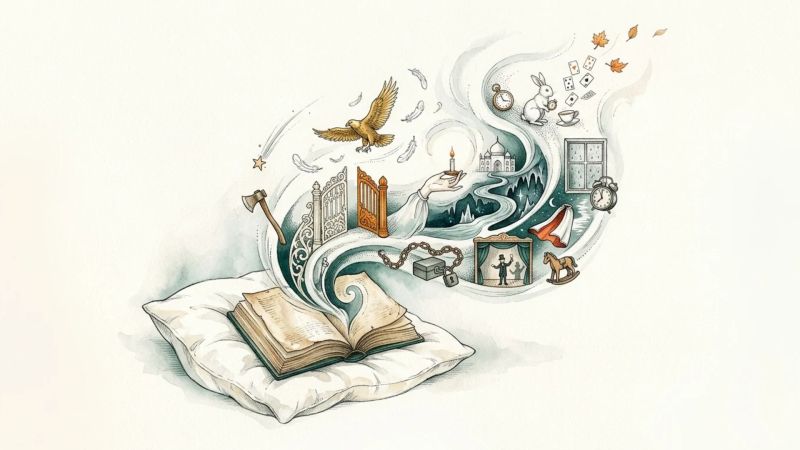
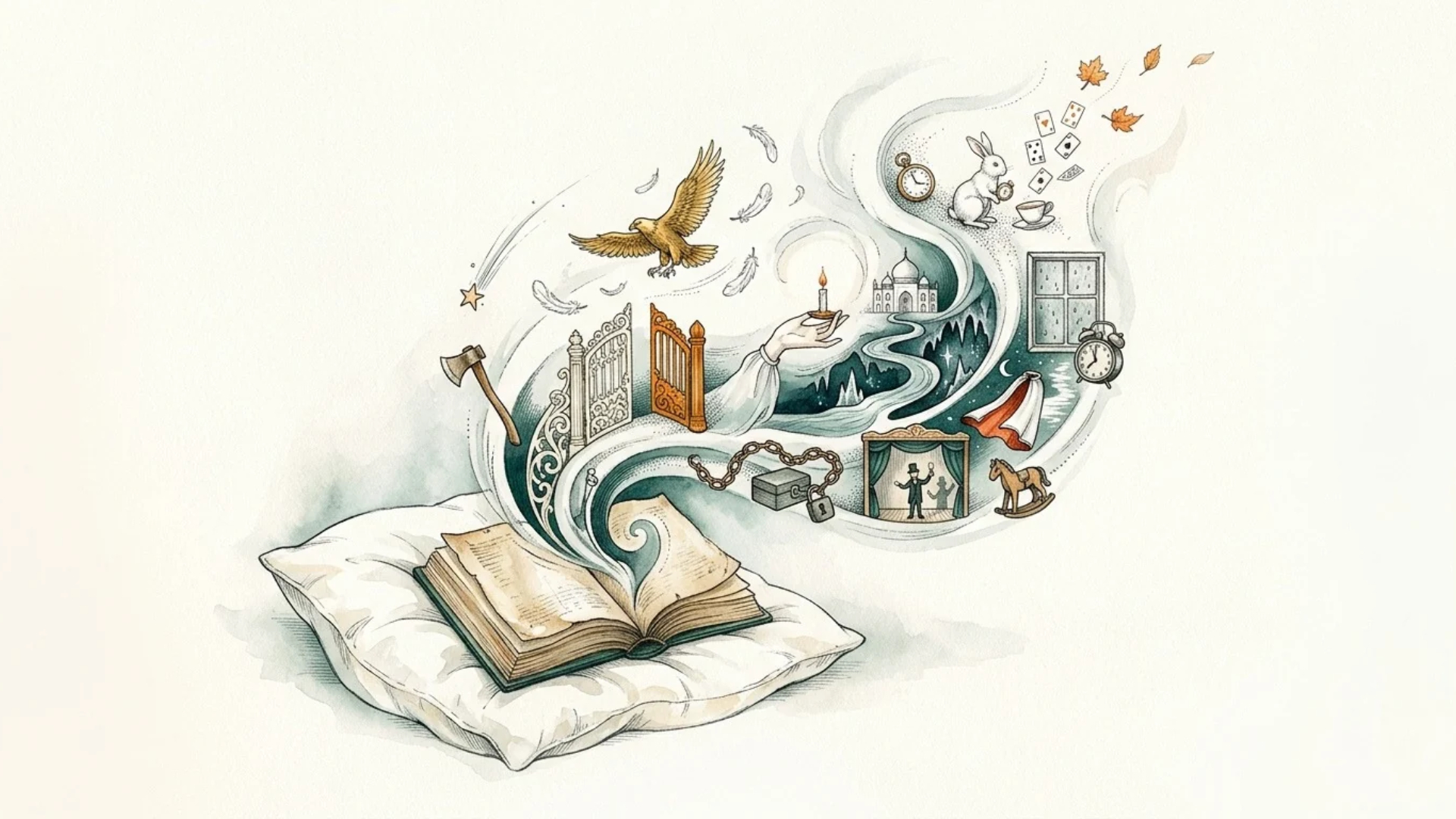
While we sleep, we live through stories nobody has ever written, and some of them feel truer than waking life itself. We meet strangers, return to places we had long forgotten, and wake with the sense that something important has slipped away from us. For centuries writers have tried to hold on to these fleeting experiences – to clothe them in words, to give them meaning and a life beyond the dream.
We have gathered ten dreams that left their mark on world literature. Some come from the oldest texts that have survived; others were born in the sleep of the writers themselves. All of them outlived the night in which they appeared and found a place in stories we still read today.

Henry Fuseli, “The Nightmare”, 1781. Detroit Institute of Arts.
❦
Ten The star that falls to Gilgamesh
Almost four thousand years ago, in the ancient city of Uruk, King Gilgamesh had a strange dream. A star fell from the sky and landed in front of him. He tried to lift it and could not. People gathered around it and paid it homage, and Gilgamesh embraced it as he would a beloved woman and carried it to his mother. On another night he dreamt of an axe lying in the middle of the street – and felt drawn to it by the same inexplicable attraction.
Ninsun, the mother of Gilgamesh and a wise goddess, listened to both dreams and explained that they were no omens of disaster. The star and the axe announced the coming of a man who would be his equal in strength and would become his closest friend. Before long Enkidu appeared out of the steppe – and one of the oldest friendships preserved in literature began.
There is something moving in the fact that among the oldest literary dreams to reach us is one that promises not war but friendship. And there is something else in it – the human need to look for meaning in what we see while asleep. The dream has to be told, and somebody else has to help interpret it. Centuries later, in the library of the Assyrian king Ashurbanipal at Nineveh, an entire series of cuneiform texts on the interpretation of dreams was kept, known today as the Assyrian Dream Book. It seems that people have never been content simply to dream. They have always wanted to know what they had seen.
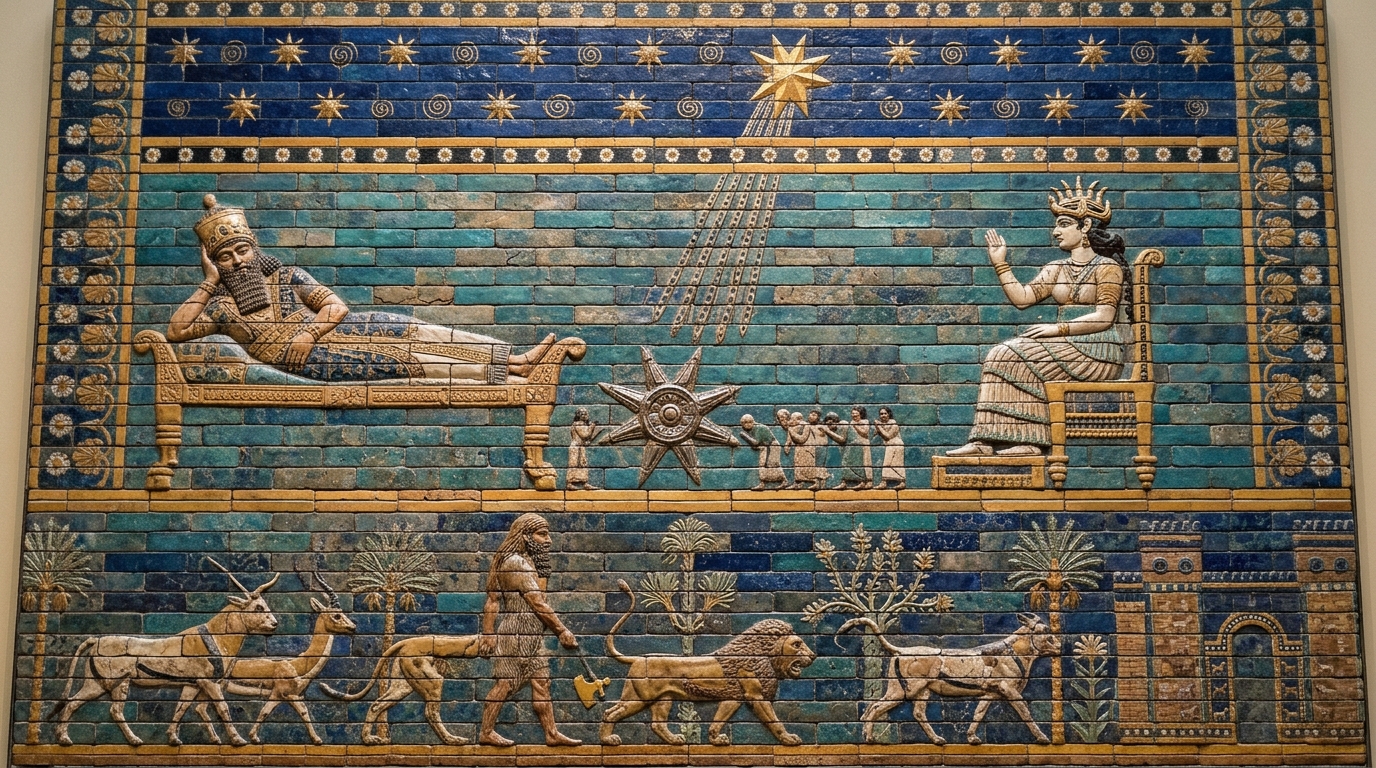
The dreams of Gilgamesh. A free interpretation of the Epic of Gilgamesh in the style of Babylonian glazed reliefs, created for this article.
❦
Nine Penelope’s two gates
For twenty years Penelope waited for Odysseus to come home. In her palace on Ithaca the suitors feasted and pressed her to choose one of them. For years she kept them waiting by a trick: by day she wove a shroud for Laertes, the father of Odysseus, and by night she unravelled what she had woven. In Book Nineteen of the “Odyssey” she tells a strange vision to an unknown stranger. She had dreamt of twenty geese pecking at grain beside the water trough. Suddenly a great eagle swooped down from the mountain and broke their necks. Penelope wept, but the eagle settled on the roof and spoke with a human voice: the geese were the suitors, and he himself was Odysseus – the husband who was coming home.

John William Waterhouse, “Penelope and the Suitors”, 1912. Aberdeen Art Gallery.
The stranger, of course, is Odysseus himself, disguised as a beggar. He assures Penelope that her vision will come true, but she remains wary. Dreams, she says, reach us through two gates. One is of ivory, and through it pass the dreams that deceive. The other is of horn, and through it come the dreams that are fulfilled.
In the Greek the contrast is sharpened by a play on words: elephas, the word for ivory, echoes the verb elephairomai, to deceive, while keras, the word for horn, echoes krainō, to fulfil. The language itself seems to separate the dreams we may trust from those that merely mislead us. The image is so powerful that centuries later Virgil carried it into the “Aeneid”. But he did something unexpected – he sent Aeneas out of the underworld through the gate of ivory, the gate of false dreams. Why he chose that one, scholars are still arguing. Perhaps because even the truest things we have seen sometimes remain in our memory like a dream.
❦
Eight Lady Macbeth’s candle
Night at Dunsinane. A gentlewoman and a doctor are standing in the corridor. Soon the queen appears, a candle in her hand. The gentlewoman explains that she insists on having a light by her bed at all times. Her eyes are open, but they see nothing. Lady Macbeth sets the candle down, begins to rub her hands as though trying to wash them, and whispers about blood that will not come off. “All the perfumes of Arabia” could not sweeten this little hand.

Henry Fuseli, “Lady Macbeth Sleepwalking”, around 1784. The Louvre, Paris.
This is one of the quietest and most frightening scenes in Shakespeare. There is no battle, no witches, no thunder. Only a woman who once urged her husband towards murder with unshakeable resolve, and now, when reason has lost its hold on her, whose body gives away what her mind is trying to suppress. Shakespeare never shows us what Lady Macbeth dreams. He shows us how she wanders through the castle asleep, a candle in her hand – the ghost of her own self.
Centuries after the first performance, this scene is still a test for every actress. There is nowhere to hide behind the words. All that is left is the walk, the hands and the empty stare. Perhaps that is why it stays with us: conscience does not deliver a monologue, it simply… walks in its sleep.
❦
Seven The person from Porlock
By Samuel Taylor Coleridge’s own account, published in the preface to the poem “Kubla Khan”, it all began in the summer of 1797. The poet was unwell and staying at a lonely farmhouse in Exmoor, England. While reading an old book of travels he came upon a description of the palace and the magnificent garden that Kubla Khan had ordered to be built at Xanadu. Shortly afterwards he fell asleep and slept for about three hours. When he woke he had the clear sense that in his sleep he had composed two or three hundred lines – without the slightest effort, as if the images had been turning themselves into words.
Coleridge seized his pen at once and began to write down what he had seen. Xanadu, the sacred river Alph, caverns measureless to man, a sunny dome and caves of ice. Line followed line. And just then a visitor from nearby Porlock arrived on business. The conversation lasted more than an hour. When Coleridge returned to his desk, most of the vision had already escaped him. Fifty-four lines remained – the fragment we know today, and one of the most mysterious poems of English Romanticism.
“Kubla Khan” was not published until 1816, at Lord Byron’s urging, with the subtitle “A Vision in a Dream. A Fragment”. How faithfully Coleridge’s account reflects what happened, and how much of the poem really came out of his sleep, is a question literary scholars continue to debate. In the meantime “the person from Porlock” has become a byword for any unexpected interruption that thwarts inspiration just as it is about to turn into something remarkable.
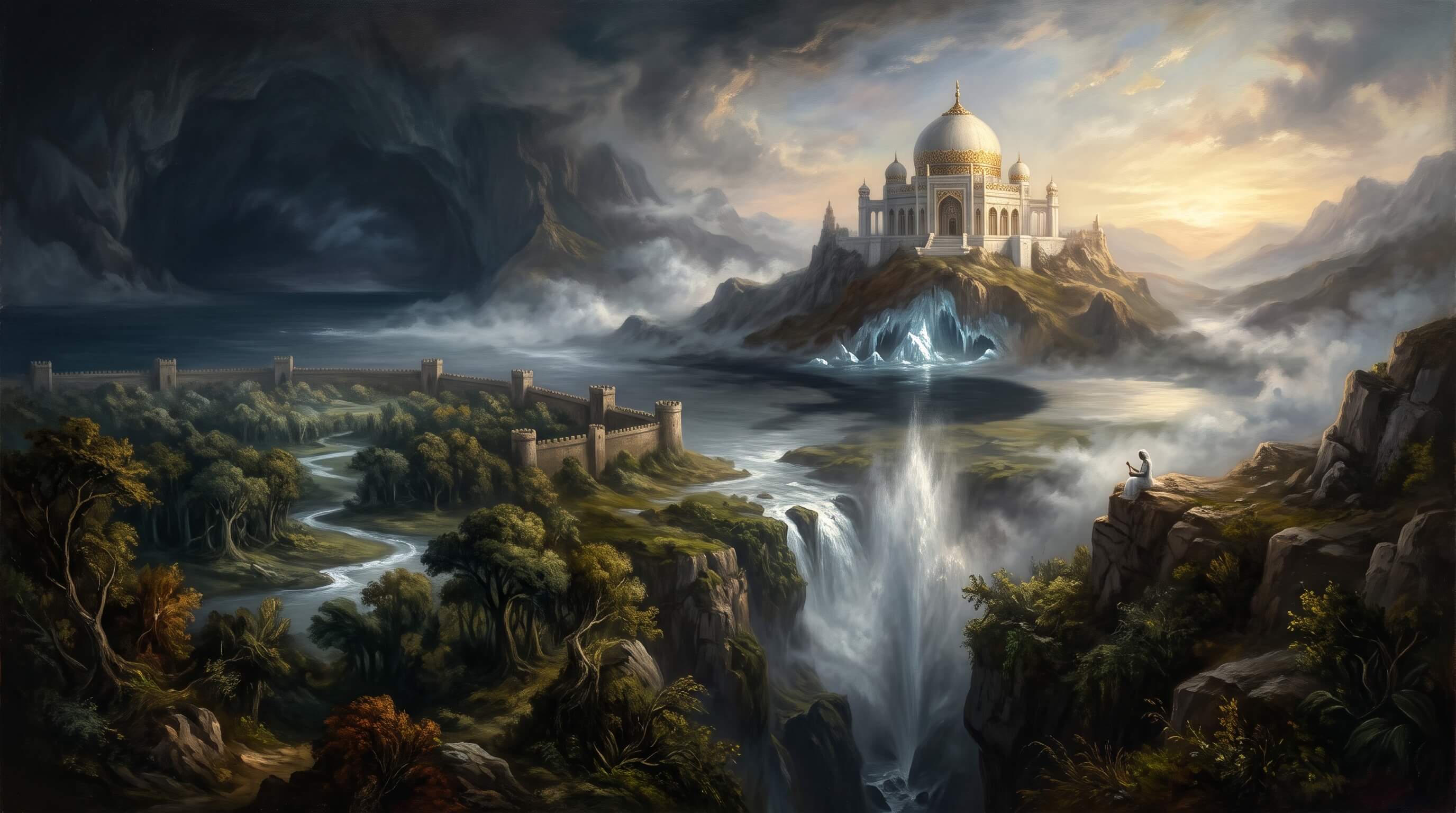
Xanadu. A free interpretation of the poem “Kubla Khan”, created for this article.
❦
Six The ghost and the undigested beef
London, Christmas Eve. Ebenezer Scrooge, famous for his miserliness, takes his dinner in his usual cheerless tavern, reads the newspapers and spends the rest of the evening over his banker’s book. Then he goes home to his gloomy house. There something awaits him that he finds hard to explain: the ghost of his late partner Jacob Marley, bound in a chain of cash-boxes, keys, padlocks and ledgers. Scrooge does not trust his own eyes and reaches for a more prosaic explanation: “You may be an undigested bit of beef, a blot of mustard, a crumb of cheese, a fragment of an underdone potato.”

John Leech, “Marley’s Ghost”, an illustration for the first edition of “A Christmas Carol”, 1843.
The line goes on with a splendid pun: “There’s more of gravy than of grave about you, whatever you are!” Gravy and grave are a single letter apart, and the absurd explanation turns Scrooge’s fear into black humour. Dickens later read “A Christmas Carol” aloud to audiences, and he can hardly have missed the chance to enjoy that line together with his listeners. And anyone who has ever eaten too much before bed can understand why Scrooge blames his supper first.
But what happened that night is hard to put down to a heavy meal alone. After Marley, three more spirits come to Scrooge – the Ghosts of Christmas Past, Present and Yet to Come. They lead him through his memories, show him his life as it is and what is waiting for him. In the morning he wakes in his own bed, throws open the window and asks a boy in the street what day it is. “Why, Christmas Day, sir!” the boy answers. All of it had happened in the course of a single night.
Dickens wrote the book in about six weeks. It came out in December 1843, only days before Christmas. Since then there is hardly a Christmas when it is not read aloud somewhere in the world.
❦
Five Stevenson’s little people
Sometimes a dream does not merely inspire a book, it sets the whole story going. Robert Louis Stevenson said that many of his plots did not feel like his own invention. They were put together instead by certain “little people” who staged entire stories before his imagination at night. He called them Brownies, after the Scottish household spirits who, according to folklore, do their masters’ work while they sleep. In his essay “A Chapter on Dreams” Stevenson admitted that these invisible helpers sometimes told a story better than he could himself.
One night late in 1885 his wife Fanny heard him cry out in his sleep and woke him. Stevenson was not at all pleased. According to family recollections he complained: “Why did you wake me? I was dreaming a fine bogey tale.” The Brownies had just shown him a scene in which a man, hunted for a crime, drinks a draught and changes, in front of his pursuers, into somebody else entirely.
Stevenson wrote the first version of the novel in a matter of days. Family accounts say that Fanny read it and felt he had missed something essential – the story ought to carry a deeper meaning rather than be a mere shocker. His stepson Lloyd Osbourne later said that Stevenson burned the manuscript and began again. How exactly this happened remains a matter of dispute. One thing is certain: the dream gave him the central idea of a man who can turn into his own opposite. So “Strange Case of Dr Jekyll and Mr Hyde” was born – a novel whose characters became a symbol of the double nature of man.
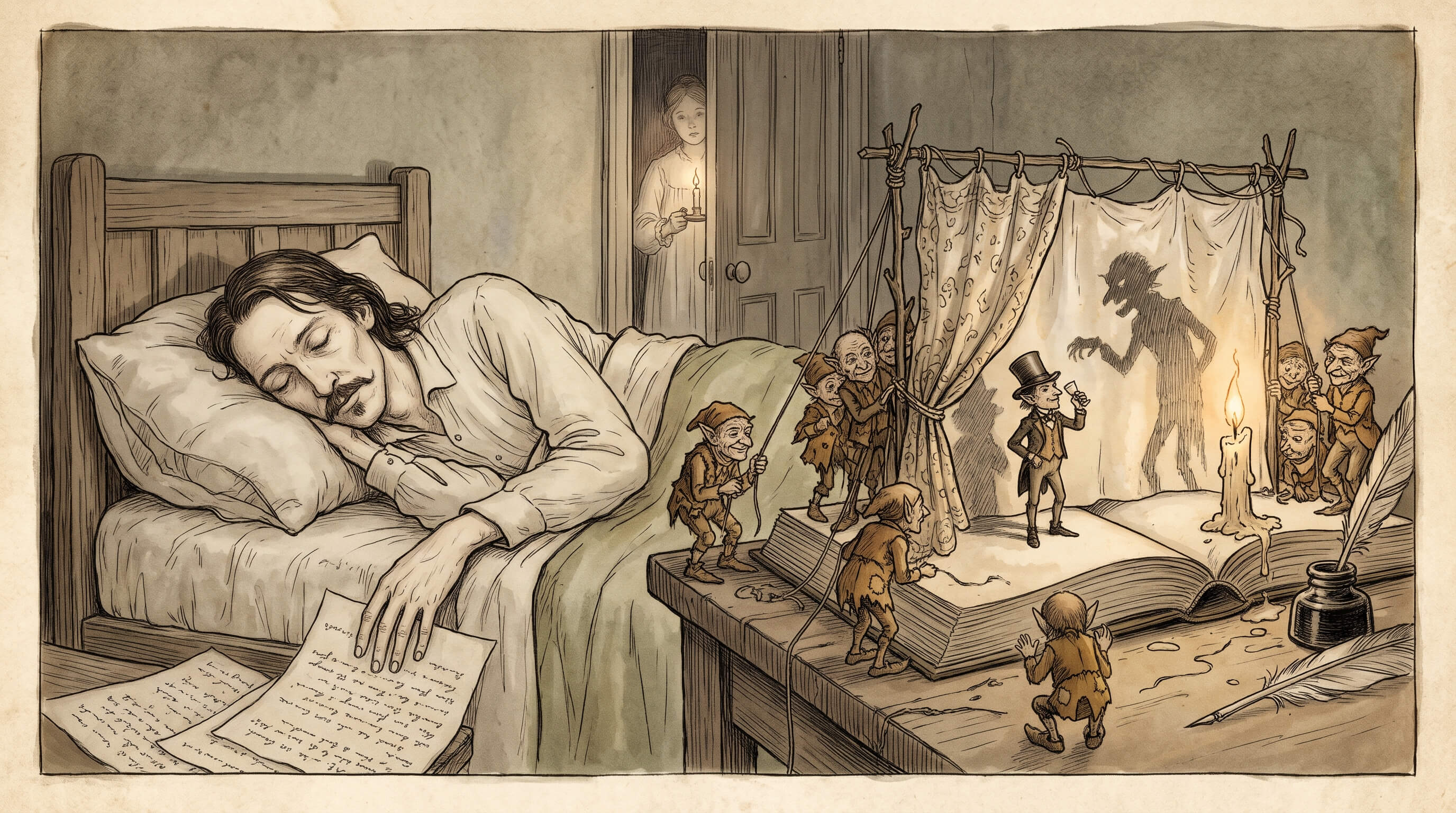
Stevenson’s Brownies. A free interpretation of the essay “A Chapter on Dreams”, created for this article.
❦
Four Raskolnikov’s mare
St Petersburg, a hot summer. The student Rodion Raskolnikov has been turning over the murder of an old pawnbroker for some time, but has not yet overcome his inner hesitation. Exhausted, he lies down to sleep in the bushes on Petrovsky Island and dreams of his childhood. He is in a small town, on a feast day, and his father is leading him by the hand. Outside a tavern a drunken peasant has harnessed an old, worn-out mare to his cart and is urging his friends to climb in. The animal can barely move under the weight, but its owner starts to beat it. The crowd laughs and eggs him on. The blows grow more and more savage until the mare collapses. The peasant goes on beating her until he has flogged her to death.
Little Rodion pushes his way through the crowd, throws himself at the dead animal, puts his arms around it and kisses its eyes and its muzzle. His father pulls him away, but the boy cannot stop crying and only repeats: “Why? Why?” Raskolnikov wakes drenched in sweat, horrified by what he has seen – and by the thought of what he intends to do.
Dostoevsky could hardly have given a clearer sign of what is happening in his hero’s soul. The dream reveals more about Raskolnikov than all his theories about extraordinary men who have the right to step over the law. Beneath them the child is still alive, the child who cannot bear another creature’s pain and cannot stand by in the face of cruelty. And yet the dream does not put an end to his hesitation. It only makes plainer what Raskolnikov will have to trample in himself in order to commit the crime. Sometimes a dream says out loud what the waking man still refuses to admit.
❦
Three The moonlit path
(A warning: spoilers for the end of the novel follow.)
“The Master and Margarita” does not end with Satan’s ball, nor with the flames over Moscow. Its last pages take us to a dream that returns every spring at the full moon. The poet Ivan Bezdomny is by now a professor at the Institute of History and Philosophy. He has left poetry behind him, but when the spring full moon comes he grows restless again. He goes to Patriarch’s Ponds, sits on the old bench, and then walks a familiar route through the lanes of the Arbat. He stops in front of the railing of a certain house and goes home. His wife knows what the night holds for him.
After the usual nightmare, in which Ivan again sees the execution of Gestas, the dream changes. From his bed towards the window stretches a broad path of moonlight. Along it, towards the moon, walks a man in a white cloak with a blood-red lining – Pontius Pilate. Beside him goes a young man in a torn chiton with a disfigured face – Yeshua. The two are talking eagerly, as if at last they were trying to understand one another. Pilate begs him to confirm that the terrible execution never took place. Yeshua assures him that he imagined it all. Behind them walks an enormous dog. But the moonlit path soon turns into a river of light, and out of it come Margarita and the Master. Ivan recognises the bearded man: it is his old night visitor from the psychiatric clinic, known there as number 118. “So that is how it ended?” he asks. “With that, my disciple,” the Master answers. Margarita bends over Ivan and kisses him on the forehead, promising that all will be well.
In the morning Ivan wakes silent, but entirely calm. The painful memories have finally subsided – at least until the next spring full moon.
Bulgakov worked on the novel for more than a decade. In the early 1930s he destroyed the early manuscript, began again and went on revising the book almost until his death in 1940. He did not live to see it published. The novel first appeared posthumously, abridged and censored, in instalments in the magazine “Moskva” – in the November issue of 1966 and the January issue of 1967, more than twenty-six years after the author’s death.
“Manuscripts don’t burn,” says Woland. At the end of the novel those words sound like a promise as well: the stories we have lived through, and the people who have left their mark on us, do not vanish without trace. In Ivan’s dream Pilate is granted consolation at last, and the story of the Master and Margarita reaches its end. And perhaps that is why the novel stays with us not for its final turn of plot, but for the image of the moonlit path – a place where even the heaviest memories can find rest.
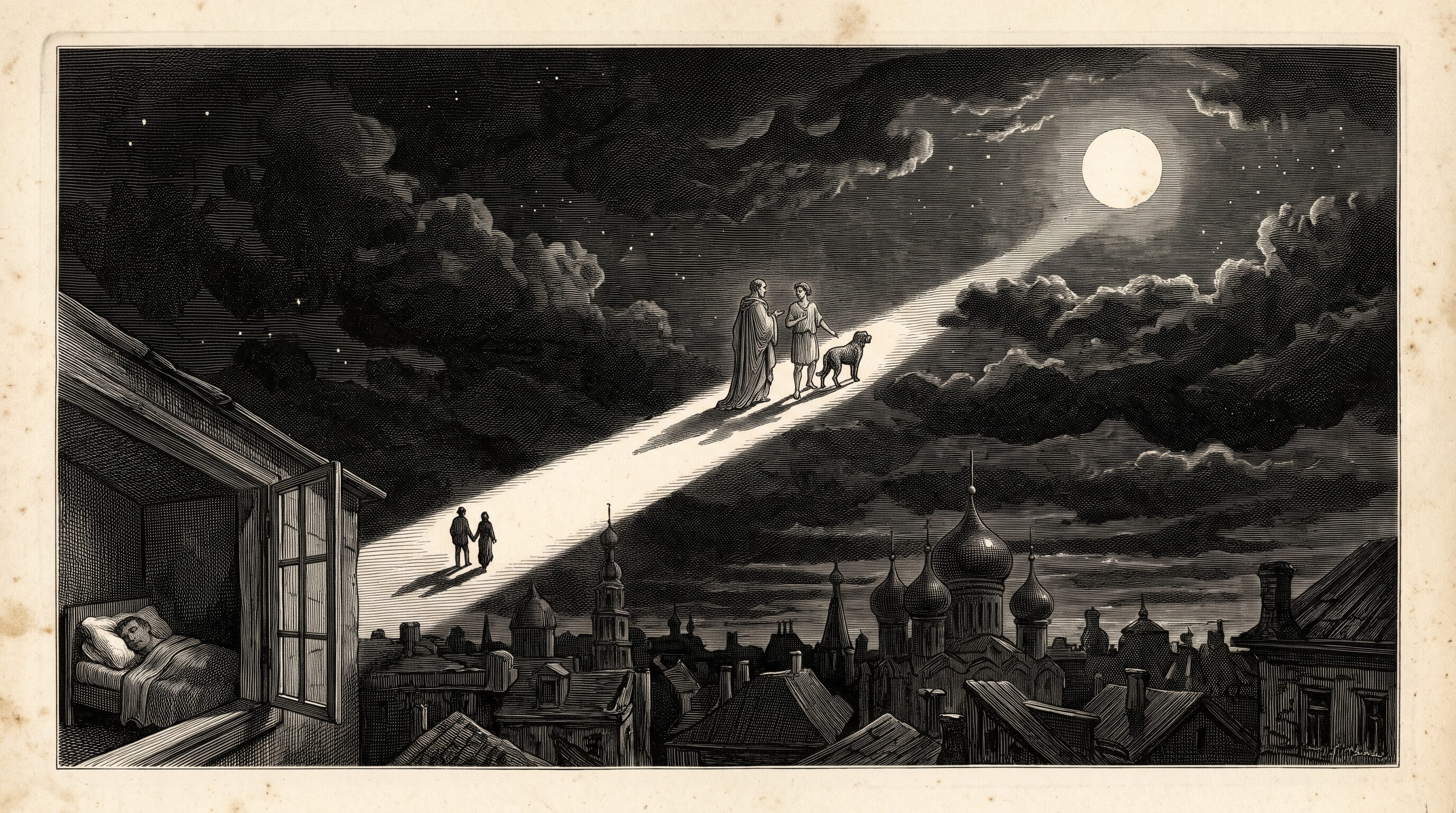
The moonlit path. A free interpretation of the epilogue of “The Master and Margarita”, created for this article.
❦
Two “It was no dream”
Few books open with a sentence more famous than the book itself. One morning Gregor Samsa wakes from uneasy dreams and finds that he has been transformed into a monstrous vermin. Kafka calls the creature by the German word Ungeziefer – a word for vermin, for some repellent thing, which names no particular species. Gregor lies on his back, his back as hard as armour, his brown belly arched, and many thin legs waving helplessly before his eyes. He tries to work out what has happened to him. And then comes the short sentence that makes the impossible undeniable: “It was no dream.”
His first bewilderment quickly gives way to far more mundane worries. He will miss his train, he will be late for work, he will have to explain his absence to his manager. This almost everyday reaction in the face of the impossible is one of the essential marks of the Kafkaesque. The world of the story obeys the logic of a dream, with one crucial difference: from this dream there is no saving awakening.
Kafka wrote “The Metamorphosis” at the end of 1912, mostly at night, while by day he carried on his work at an insurance institute in Prague. The story first appeared in October 1915 in the literary magazine “Die weißen Blätter”, and in December of the same year it was published as a book in its own right. While the edition was being prepared, Kafka made a firm request of his publisher: the creature was on no account to be drawn on the cover – not even at a distance. Let the reader imagine it instead, the way we see things in a nightmare: with the feeling that they are perfectly clear, even though we cannot name them.
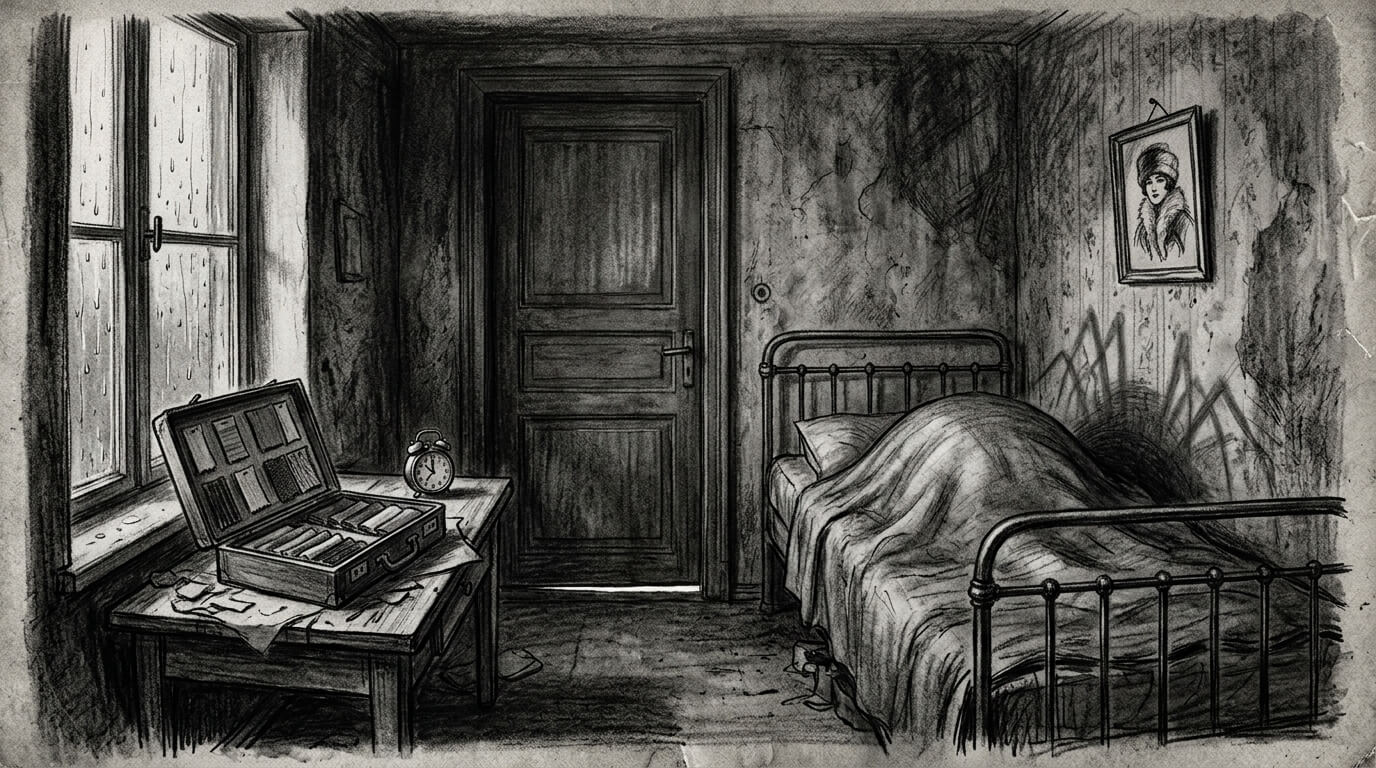
Gregor Samsa’s room. A free interpretation of “The Metamorphosis”, created for this article.
❦
One Alice’s golden afternoon
On 4 July 1862 a young Oxford mathematics lecturer, Charles Lutwidge Dodgson, set out in a rowing boat on the Thames with his friend the Reverend Robinson Duckworth and the three daughters of the Dean of Christ Church – Lorina, Alice and Edith Liddell. The afternoon was sunny, the boat slid slowly along the river, and the girls insisted on a story. Dodgson began to tell them about a girl who follows a White Rabbit with a waistcoat and a watch and falls down a rabbit hole. Ten-year-old Alice liked the story so much that she begged him to write it down. He promised he would.
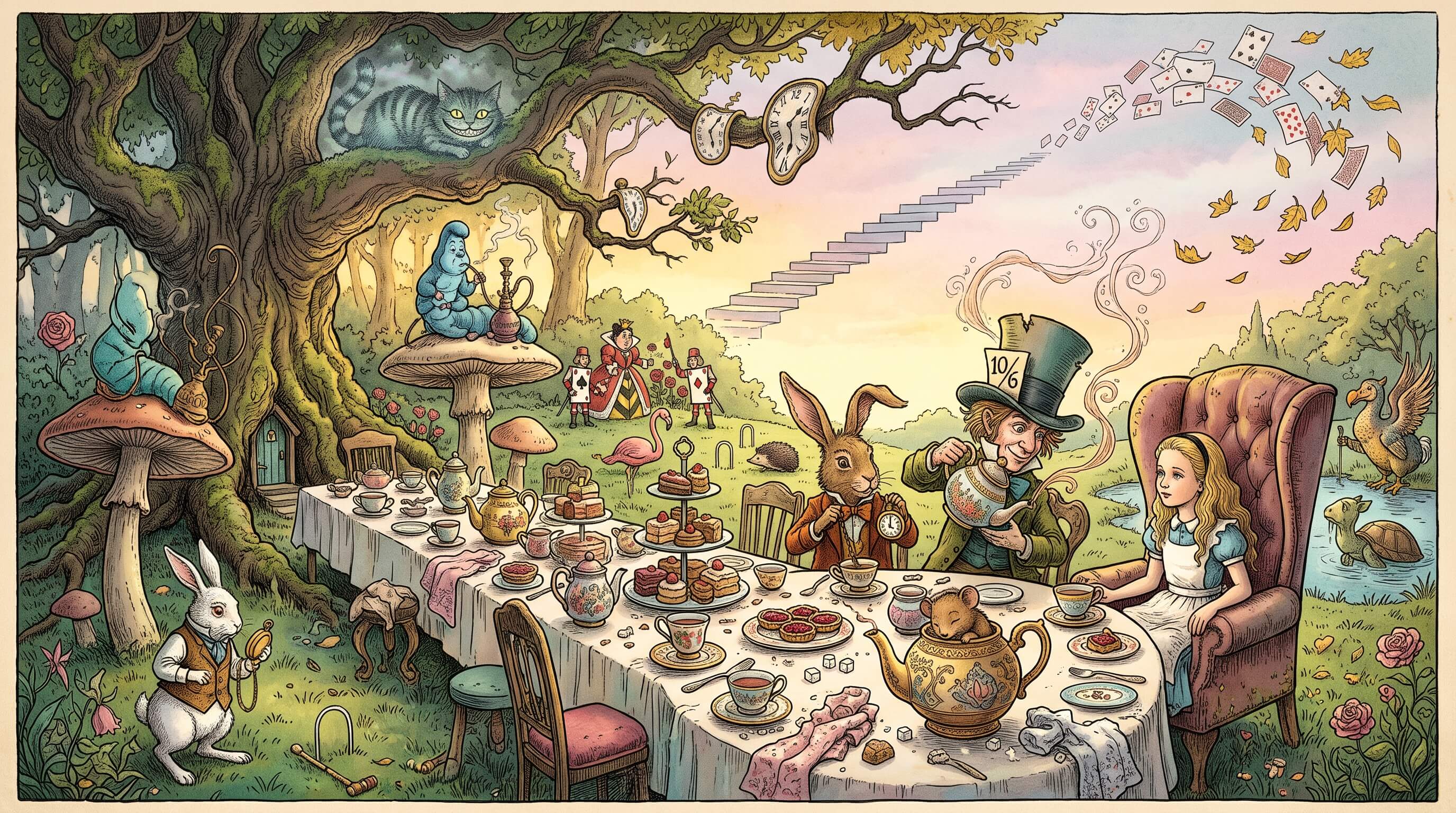
The tea party and Wonderland. A free interpretation of the book by Lewis Carroll, created for this article.
Three years later, under the pen name Lewis Carroll, Dodgson published “Alice’s Adventures in Wonderland”. At the beginning of the book Alice is sitting on the bank beside her sister, bored, while her sister reads a book with no pictures or conversations in it. Then the White Rabbit runs past her and the adventure begins. Only at the very end do we learn that it was all a dream. When the pack of cards flies at Alice, she starts and opens her eyes. She is lying with her head in her sister’s lap, and her sister is gently brushing away a few dead leaves that had fluttered down from the trees . The noisy, absurd world of Wonderland disappears as suddenly as most dreams dissolve.
But perhaps the loveliest part of the book is its epilogue. After Alice has run off to her tea, her sister stays behind on the bank. Watching the setting sun, she slowly drifts into a reverie. In her imagination the White Rabbit, the Mouse, the Mad Hatter and the rest of the strange creatures come alive once more. Then she pictures her little sister’s future: how one day Alice will grow up, yet keep the simple and loving heart of her childhood; how she will gather children around her and tell them wonderful stories, perhaps even the story of that long-ago dream in Wonderland.
So Carroll ends the book not merely with an awakening but with a promise: imagination does not disappear together with childhood. It passes from one generation to the next, through the stories we tell and the books we leave behind us. And perhaps that is how literature manages to turn a single golden afternoon into something that lasts a lifetime.
❦
There is an epilogue here too
Set side by side, the ten dreams turn out to be almost never only about dreaming. For Gilgamesh they are a promise of friendship, for Penelope a test of trust. For Lady Macbeth and Raskolnikov conscience finds a way to speak. For Coleridge and Stevenson the dream becomes a workshop for stories, for Scrooge a chance at a second life, and for Bulgakov a consolation. For Kafka it is a nightmare with no waking, and for Alice a space of play and imagination that can be handed on from one person to another.

Robert William Buss, “Dickens’s Dream”, 1875, unfinished. Charles Dickens Museum, London.
Writers have long suspected what sleep science is gradually uncovering: the sleeping brain is not idle. It works through what we have lived, strengthens and reorders memories, links them to emotions and sometimes makes unexpected connections between things that seem to have nothing in common. How dreams arise and what they are for are questions researchers are still working on. You can read more about what we know today in our article “Why we dream”.
Until then – good night. And if somebody tells you a story in your sleep tonight, try to remember it before your own person from Porlock arrives.
❦
Works and sources
“The Epic of Gilgamesh”, Tablet I. Homer, “Odyssey”, Book XIX, lines 535–569. Virgil, “Aeneid”, Book VI, lines 893–898. William Shakespeare, “The Tempest”, Act IV, Scene 1, and “Macbeth”, Act V, Scene 1. Samuel Taylor Coleridge, “Kubla Khan”, the 1816 edition with the author’s preface. Charles Dickens, “A Christmas Carol”, Stave One, “Marley’s Ghost”. Robert Louis Stevenson, “A Chapter on Dreams” (1888). Fyodor Dostoevsky, “Crime and Punishment”, Part I, Chapter V. Mikhail Bulgakov, “The Master and Margarita”, Chapter 24 and the epilogue. Franz Kafka, “The Metamorphosis”, Part I. Lewis Carroll, “Alice’s Adventures in Wonderland”, Chapter XII.
Stefan M. Maul, “Signs During Sleep: Dream Omens”, on the Mesopotamian tradition of dream interpretation. Louise Welsh, “Robert Louis Stevenson and the Theatre of the Brain”, Journal of Stevenson Studies, on the story behind “Jekyll and Hyde”. British Library, the manuscript “Alice’s Adventures Under Ground”, on the origins of “Alice”.
Quotations from Shakespeare, Coleridge, Dickens, Stevenson and Carroll are given in the original English. The passages from Gilgamesh, Homer, Virgil, Dostoevsky, Bulgakov and Kafka are retold by the author.
Date: 05 Nov 2026
Post comment